
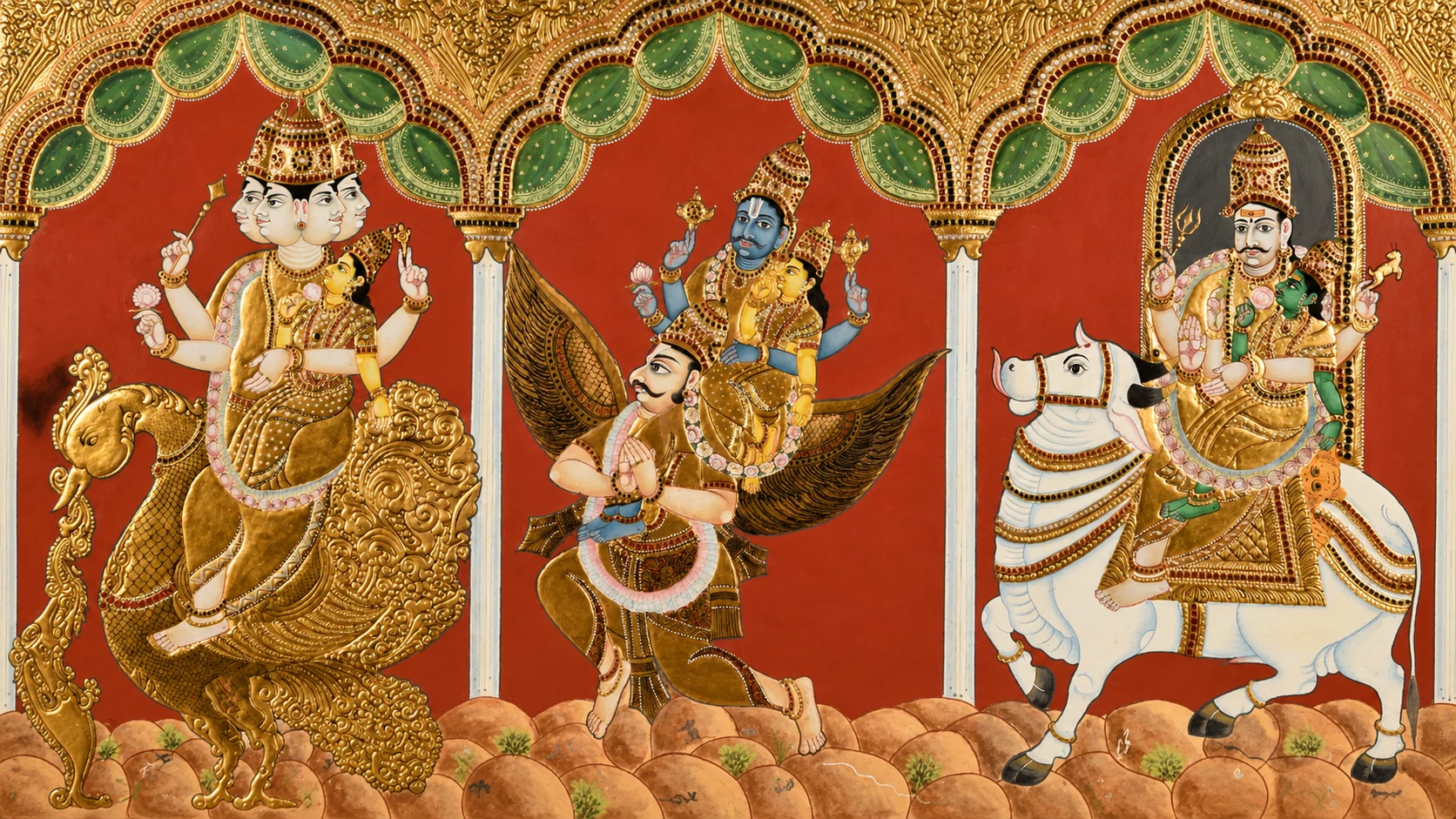
Ask most people why Hinduism has three principal gods - Brahma, Vishnu, and Shiva - and you'll get the textbook answer: Brahma creates, Vishnu preserves, Shiva destroys. It's accurate, but it's also strangely unsatisfying. Why would a tradition need a cosmic committee just to run the universe? And more importantly - what does any of it have to do with your Tuesday afternoon?
Here's a different way to read it. Not as astrophysics, but as a manual.
The Trinity Isn't Just About the Cosmos - It's About You
Step back from "who created the universe" and look instead at what each god actually does, and who stands beside him.
Vishnu doesn't just preserve galaxies. He preserves life - and he's never shown without Lakshmi, the goddess of wealth and abundance, because sustaining anything living requires resources. Food, shelter, money, medicine - the material means of staying alive and well.
Brahma doesn't just originate matter. He originates thought - every idea, every plan, every story you tell yourself. And beside him stands Saraswati, goddess not of wealth but of discernment - the intellect that can tell a good idea from a self-serving lie.
Shiva doesn't just end things. He represents what remains when everything endable has ended - consciousness itself, still, infinite, asking for nothing. He is shown not accumulating or scheming, but meditating.
Read this way, the trinity isn't a story about how the universe began. It's a diagram of the three things every human life is actually built from: a body that needs care, a mind that needs discipline, and a spirit that needs stillness.
Three Gods, Three Disciplines
Put simply:
- Care for the body - with wealth: This is Vishnu and Lakshmi's territory. The body isn't something to transcend or ignore; it's something to maintain, and maintenance takes resources. Nutrition, medicine, shelter, financial stability - these aren't spiritually inferior concerns. They're the discipline of sustenance, and Hinduism gave it its own god and goddess because a tradition that starves its body isn't wise, it's careless.
- Govern the mind - with intellect: This is Brahma and Saraswati's territory. The mind never stops generating - plans, worries, justifications, stories. Left alone, it doesn't rest; it defends itself, often with lies it half-believes. Saraswati represents the discipline that keeps the mind honest: reason applied against your own ego, not just the world's.
- Merge the spirit - through meditation: This is Shiva's territory, and notably, he needs no consort to complete this one - Shakti here is not a separate helper but his own dynamic power turned inward. Where the body is cared for and the mind is governed, the spirit isn't managed at all - it's dissolved into. Meditation isn't another form of self-improvement; it's the one discipline aimed at un-becoming the self altogether.
The Story That Makes This Concrete
There's an old Shaiva myth - the Lingodbhava - that dramatizes this better than any explanation can.
Vishnu and Brahma are arguing over who is greater. A pillar of infinite fire appears between them - Shiva, in his boundless form - and they're challenged to find either end of it. Vishnu, as the boar Varaha, digs downward into the earth for eternity and never finds the base. Brahma, as a swan, flies upward for eternity and never finds the top.
Here's the part worth sitting with: Vishnu comes back and admits he failed. He simply couldn't reach the end - the body's effort has limits, and he says so.
Brahma lies. He claims he did find the top, and even produces a flower as false evidence.
Vishnu is honored for his honesty. Brahma is cursed - and it's said this is why, to this day, temples to Brahma are almost nonexistent in India, while Vishnu and Shiva are worshipped everywhere.
The lesson isn't subtle: the body gets tired and tells the truth. The mind never tires - and that's exactly what makes it dangerous. Unchecked, it will manufacture whatever story protects itself. The myth rewards surrender over self-deception, effort honestly reported over cleverness dishonestly deployed.
And at the center of it all stands Shiva - not competing, not measured, needing no beginning or end because he has none. The infinite doesn't have to prove itself. It simply is.
So Why Three Gods?
Because one god trying to do all three jobs would be a contradiction. The discipline that keeps you alive (accumulate, provide, sustain) is not the discipline that keeps you honest (question, refine, discern) - and neither of those is the discipline that dissolves the self (release, still, merge). They pull in different directions.
Hinduism didn't force them into one figure; it gave each its own god, its own consort, its own myths - and then, through stories like the Lingodbhava, showed how they relate: the body should serve honestly, the mind should be watched carefully, and beneath both, unmoving, is the thing neither can measure.
That's not a cosmology lesson. That's a life plan - one most of us are still trying to follow, whether we've read the myths or not.