
Strip away the language, the ritual, the century, and the geography - and a strange thing happens. The saints, sages, and mystics of every tradition start to sound like they are describing the very same experience. Not a shared belief. Not a shared doctrine. A shared discovery.
They call it different names - the Self, the Witness, the Kingdom of God, the Buddha-nature, the ground of the soul, the inner light. But strip the names away, and what remains is identical: a silent, unmoving awareness at the center of every person, untouched by circumstance, discovered rather than believed in. This is the truth the Seventh Discipline points toward - not a philosophy to accept, and not a religion to join, but a plain fact of experience waiting to be noticed. Here is how some of the enlightened souls across history have each pointed at it, in their own words and their own way.
The Vedic and Vedantic Sages
Ramana Maharshi: His entire teaching reduced to one question - "Who am I?" - turning attention backward until only the silent witness behind the question remained. He insisted this Self was never absent, only overlooked.
Nisargadatta Maharaj: In his conversations recorded as I Am That, he described "witness consciousness" as prior to any sense of being a body or a mind - something to abide in, not something to attain.
Adi Shankaracharya: He gave this witness a name - Sakshi - and showed it to be the one constant across waking, dreaming, and deep sleep, unchanged no matter which state the mind moves through.
The Upanishadic Rishis: Long before any of them, the unnamed sages of the Upanishads described the Atman as the silent seer within - unborn, eternal, untouched by the body's changes.
Ashtavakra: To a young king, he taught that the search itself was the obstacle - one is already the witnessing awareness, free before any effort begins.
Sri Ramakrishna and Sri Aurobindo: Ramakrishna spoke of this same recognition as Sat-Chit-Ananda, existence-consciousness-bliss, tasted directly in deep meditation. Aurobindo described a witness consciousness quietly underlying every movement of mind and nature.
The Buddhist Path
The Buddha did not describe a soul to be found, yet he pointed at the same clearing: a bare awareness that knows experience without clinging to it. Centuries later, Zen masters such as Bodhidharma, Huang Po, and Dogen distilled this into the practice of simply sitting - shikantaza - resting in awareness itself, before a single thought arises.
The Sufi Mystics
Rumi's poetry circles endlessly back to a silent beloved discovered within, never truly separate from the seeker. Al-Hallaj and other Sufi mystics spoke of fana - the dissolution of the separate self - as the doorway to the same unchanging awareness.
Christian Mysticism
Meister Eckhart described a "ground of the soul" untouched by circumstance, where the self and the divine are not two things but one. And in the gospels themselves, the teaching "the Kingdom of God is within you" points to an inner reality that owes nothing to outer conditions.
The Sikh and Taoist Traditions
Guru Nanak spoke of the jyot, the inner light present in every being without exception - the same light in every lamp. Lao Tzu, in the Tao Te Ching, described the sage who acts without forcing and observes without grasping - the same unmoved awareness at the center of a busy life.
Modern Voices, Same Discovery
J. Krishnamurti spent a lifetime insisting this wasn't a technique or belief but "choiceless awareness" - direct seeing, available to anyone, right now. Osho used the word "witnessing," sakshi bhav, as the common thread running under every religion's outer form. Eckhart Tolle brought the same recognition into modern language as "presence." And Ramesh Balsekar, a direct student of Nisargadatta, carried the witness perspective forward in plain, contemporary English.
One Moon, Many Fingers
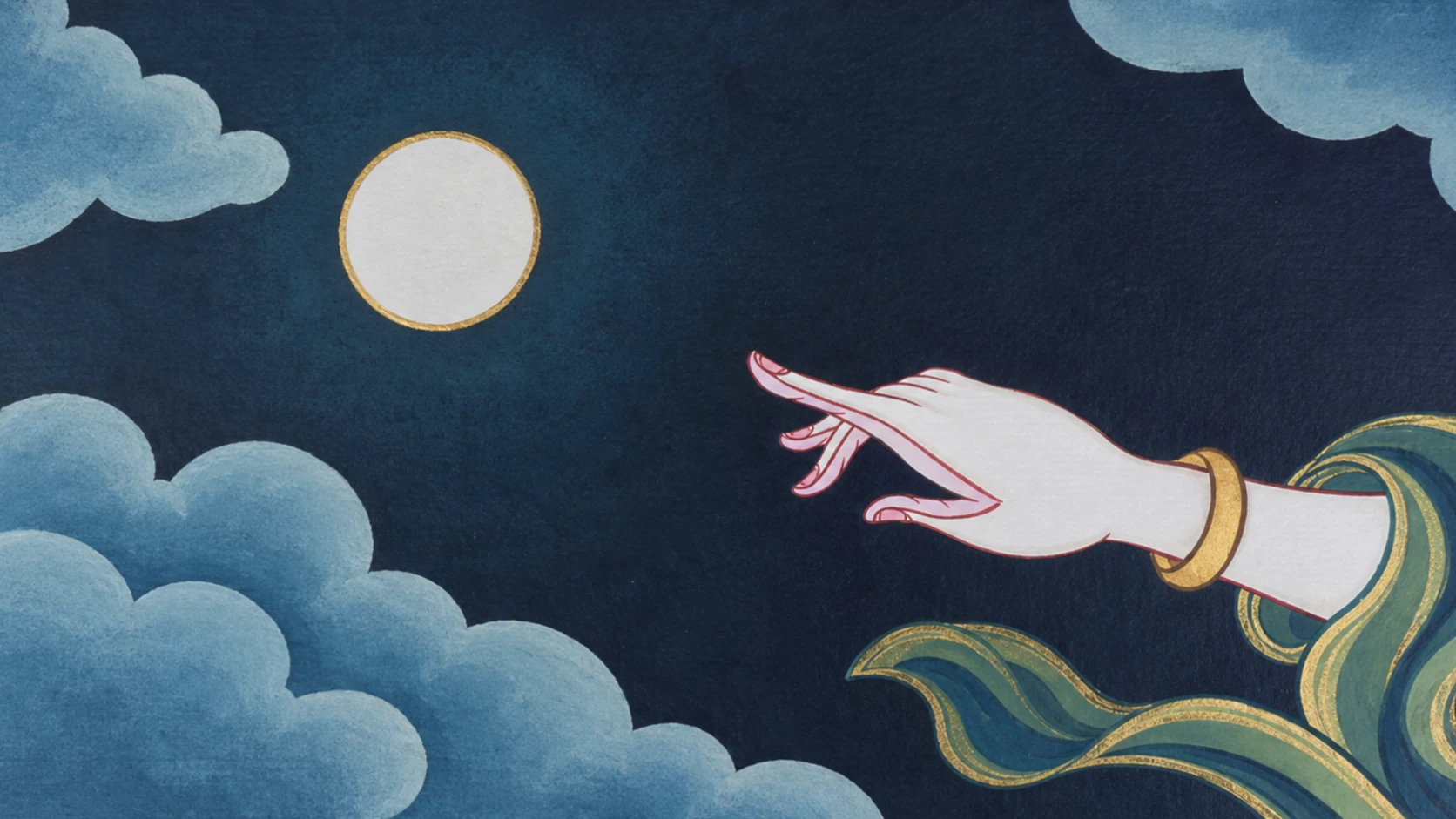
None of these voices claimed to invent what they described. Each one insisted, in their own way, that they were only pointing - the way a finger points at the moon. The finger changes from age to age, from language to language, from robe to robe. The moon does not.
This is why the experience described in the Seventh Discipline is beyond philosophy and beyond religion. It does not ask to be believed. It asks only to be noticed - the same silent witness that every tradition, in its own tongue, has been quietly pointing toward all along.
The finger changes from age to age, from language to language, from robe to robe. The moon does not. Look at the moon.
One Life: Live it well
Sukhama Santhoshama Ananthama