Sree Murugan Research Centre (SMRC) was born not out of an academic plan, but out of a quiet family prayer, deep spiritual devotion, and a remarkable sequence of divine synchronicities.
1. The Spark – A Divine Intention
It began, as many things do, with an ordinary family conversation. My uncle, V.M. Balasubramanian, was chatting with the family and shared his long-held longing - to do something worthy of the land and building he had dedicated to the Mottairasu Vasanthotsavam, the annual festival of Thiruparankundram's Lord Subramanian.
I overheard him while I was in the middle of my evening prayers. A thought flashed into my mind: we could start a research centre dedicated to Lord Murugan. I walked straight out of the pooja room and told him so. He agreed, at least in part - "We can think about it," he said.
My mother, hearing this, said something that stayed with all of us: "Today is Visaka Nakshatra - Lord Murugan's birth star." Perhaps, she said, Murugan wanted this to happen.
2. The Fuel – Human Effort
A year passed. On 20th June 2025, at a family birthday gathering, my uncle raised the topic again. Once more I said, "Let's start the research centre." We weighed the pros and cons together as a family, and this time we decided - let's go ahead.
For the next six months, my uncle devoted himself fully to the legal and banking formalities needed to bring the idea into being.
3. The Birth of the Name
Naming the centre proved harder than expected. Days passed without a decision. Then, one evening, we visited Mylapore Kapaleeswarar Temple and stood before the Sri Singaravelar Sannathi. I found myself praying quietly: Lord, give us the right name for the centre.
At that very moment, a loudspeaker from the nearby temple auditorium hall crackled to life, reciting the many names of Lord Murugan and their meanings - beginning with "Murugan" itself. I felt it was a message. Right there, we decided the centre would be called Murugan Research Centre. My uncle later refined it to Sree Murugan Research Centre - and that is how SMRC was born.
4. The Research Begins
Lord Murugan's mythology is, of course, well documented - through the Skanda Puranam, ancient literature, and folklore. Yet as we began our work, we felt intuitively guided at every step, drawn toward the deeper, lesser-known layers: the rahasyas of Murugan's mythology, worship, ritual, and secret traditions.
We received insight after insight - into Murugan iconography, the six abodes (Arupadai Veedu), and their connection to the body's chakras. His teaching of Thannai Thaan Arithal - knowing the self by the self - became the seed of our very first research output.
5. Lord Murugan and the Disciplines of Life
As our research deepened, a question kept surfacing: how do we connect Murugan's mythology to the needs of today's world?
The answer arrived unexpectedly. I was in Nepal for an official meeting when my friend Mr. Sathish Kondakath sent a message: "If possible, please go to Shri Shivapuri Baba Ashram - it's in Kathmandu." I replied that I was leaving the next morning and doubted I'd manage it. Even local contacts had never heard of Shivapuri Baba.
Then, by chance - or grace - I found online that the ashram was near the airport, right beside the Pashupatinath Temple. Shivapuri Baba had lived on this earth for nearly 137 years, walked the world on foot for 40 of them, and had been a teacher to Queen Victoria and to thinkers like Dr. S. Radhakrishnan.
I made it to the ashram, received his blessings, and was gifted a book on his teachings by one of his disciples - teachings centred on Swadharma, the disciplines of a rightly lived life. It was only later that the realization struck me: Lord Murugan himself is the living exemplar of these disciplines. His life and mythology are a practical guide to right living for everyone.
6. The Logo "Gnanavel" Is Born
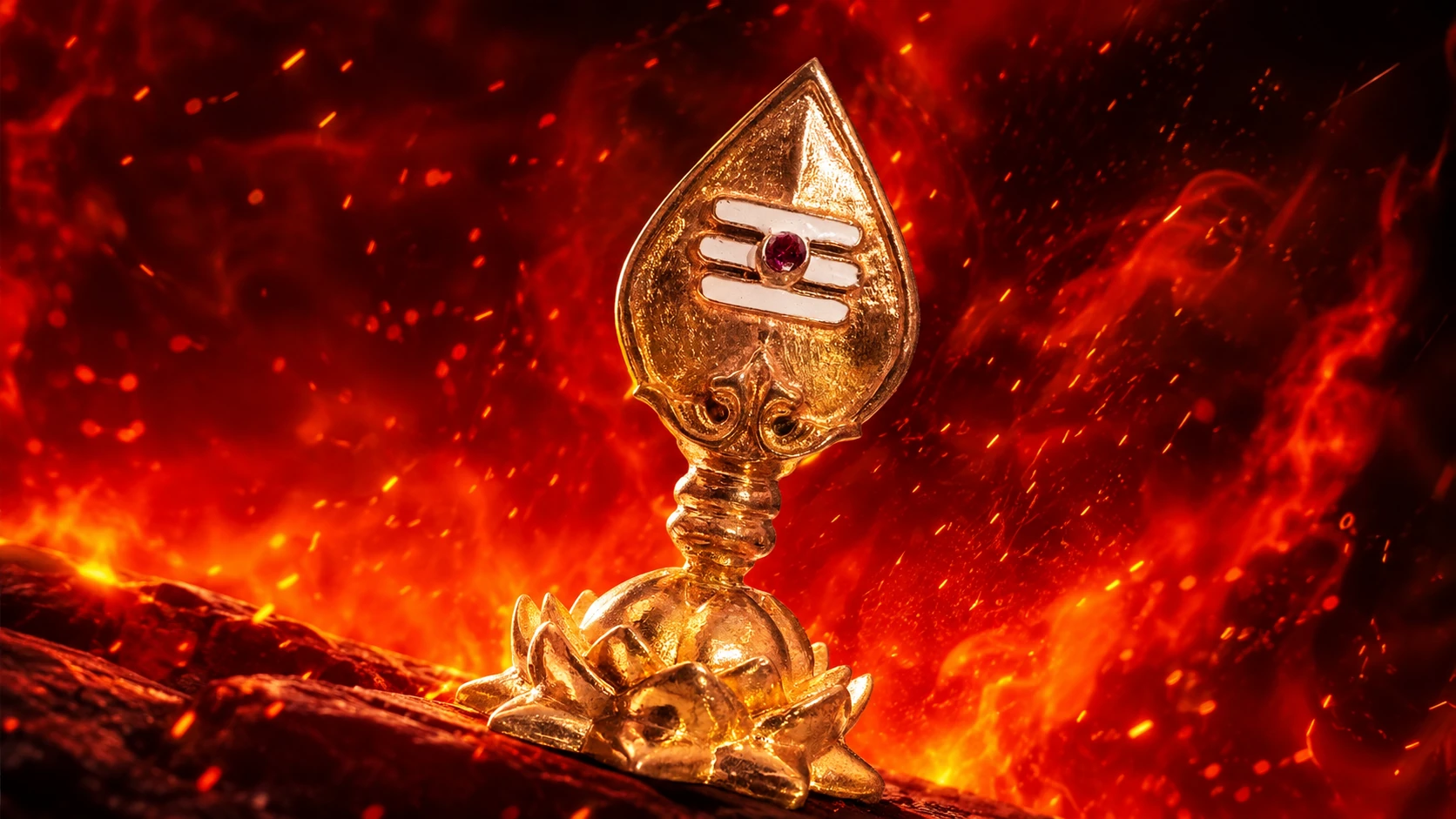
With the name SMRC settled, we began searching for a logo to represent it. One day, a colleague of mine - Mr. Mani, a creative designer - happened to visit a well-known shop that sells idols of the gods. There, he found a divine Vel rising from a lotus, cast in Pancha Loha, the traditional alloy of five metals. Something about it drew him in immediately.
He bought a few and brought them to me. The moment I saw it, I knew - this was the logo. We named it Gnanavel - the piercing wisdom - the true essence of Lord Murugan's Vel, and the very purpose of SMRC: spreading the wisdom of Lord Murugan.
7. Submitted at the Feet of Lord Subramanian, Thiruparankundram
After sustained effort, my uncle completed the trust registration and received the documents. On 25th December 2025, Christmas holiday, our whole family gathered at our Madurai home. As my uncle showed us the paperwork, someone suggested - why not go and seek the Lord's blessing at Thiruparankundram?
We travelled to the Subramaniar Temple, where our contact Dhakshinamoorthy welcomed us and helped us place the registration documents at the feet of Lord Murugan for his blessings. It felt as though God himself had approved SMRC and given us the go-ahead to proceed.
From there, we went straight to the Mottairasu festival building - SMRC's registered office - and discussed the road ahead. The first draft of our research output, Thannai Thaan Arithal, was distributed that day, and every family member present received a Gnanavel, our newly-born logo.
8. Consecration of Gnanavel at SMRC
That day, we made our most important decision yet: to establish a dedicated presence for SMRC. As we discussed when to meet next, our family member Vanathi suggested we mark Thai Poosam, then just months away, with some meaningful activity.
I kept turning the question over in my mind - trusting that Lord Murugan would show the way.
9. Thai Poosam (1 February 2026) – The Day
I discussed it with my close friend and colleague, Mr. Sathish Kondakath, and we resolved to begin with an interview - capturing my uncle's account of the 100-year legacy of the Mottairasu festival and its heritage.
As it happened, Thai Poosam fell on Sunday, 1st February 2026 - a holiday. We booked tickets for three of us: myself, Mr. Sathish, and Mr. Mani, our creative designer, who is also skilled in photography and videography.
10. Getting the Gnanavel
We had planned only a video shoot. But a thought kept returning to me - Thai Poosam is one of the most auspicious days for Murugan; this should be the official launch day of SMRC, something truly significant, a divine beginning.
While reading about the significance of Thai Poosam, I learned it marks the day Lord Murugan received his Vel from Amma Parvathi. In an instant, the idea struck: let us consecrate the Gnanavel, our SMRC logo, on this very day.
11. Search for a Priest
I asked Mr. Mani to buy a larger Gnanavel from the same shop as before. Word came back - none in stock, and a fresh order would take days we didn't have. I sat with that for a while, unsure what to do next, and simply prayed. Soon after, Mani messaged again: the shop had a branch in Kanchipuram, and there was a chance a larger one might be sitting there.
By the grace of Lord Murugan, exactly one was in stock. We ordered it at once, and it reached us by courier just a day before our travel - with no margin left to spare.
With the Gnanavel in hand, I thought to invite a priest from the Thiruparankundram Murugan Temple to SMRC, for a small pooja and a talk on Lord Murugan. Every attempt came back the same way - everyone was occupied with Thai Poosam duties at the temple, and the notice was simply too short. I began to wonder if we'd have to let the idea go for this year.
12. Consecration by Swami Kamalanantha
My uncle then approached a nearby temple priest with the same request. He couldn't help either - but he mentioned a saint living close by. What struck us was this: my uncle had lived in that very locality of TVS Nagar, Madurai, for decades, and had never once known a saint resided there - one who had taken sanyasa from the Sringeri Sharada Peetham, in the lineage of Adi Shankara. It made us wonder how many such quiet answers had been sitting nearby all along, unnoticed.
When my uncle went to the ashram, the reply was that Swamiji had an important function that very morning and could only meet in the evening. Our return train, though, was at 5 PM - so he asked once more for a morning slot, and came home believing it likely wouldn't work out.
Then, unexpectedly, a call came from the ashram - the saint had agreed to make time for us that morning, at 11 AM.
13. The Anchor
Then came a sudden twist: my friend Mr. Sathish could no longer travel with us. With a spare ticket in hand, I asked Mani to reach out to his uncle, Mr. Shankar, a friend of mine, to see if he could join instead.
To our surprise, Mr. Shankar - a busy teacher - agreed at such short notice. When we met at the railway station, he asked me, "Why did you want me to join this program?" I honestly didn't have an answer - Sathish couldn't make it, and his name had simply come to mind, unbidden. All I could tell him was that there must be a reason; God alone would know. Neither of us could have guessed, standing on that platform, how true that would turn out to be.
14. God's Play at Kamalanantha Ashram
When we met my uncle in Madurai, I showed him the Gnanavel and explained we wished to consecrate it at SMRC. He agreed. The moment we reached the ashram, a pooja was already in progress, conducted with great devotion. I asked the Swami if he could perform the pooja for the Gnanavel, so we could consecrate it at SMRC.
15. Research Finding and the Proof
He agreed wholeheartedly and performed a sincere prayer, abhishekam, and aarti. Afterward, he shared something remarkable - his original name was Murugan, and Thai Poosam was the very day of his sanyasa deeksha from his guru. The special pooja that morning had been organised for that occasion alone.
He was deeply moved that the Gnanavel had arrived at his ashram on this exact day, feeling that Lord Murugan himself had come to bless him. After the pooja, he handed us the Gnanavel with his blessings, and spoke to us about Subramanya Rahasya - the connection between Lord Thiruparankundram Murugan and the Mooladhara Chakra.
I was astonished and delighted - our core research had centred precisely on the six Padai Veedu and their connection to the six chakras of the human body. We had sensed this intuitively all along, but had longed for solid grounding to include in our research. Here it was, unasked for.
16. Mission - "One Life: Live It Well" Begins
Straight from the ashram, we went to the SMRC building and consecrated the Gnanavel at the pooja hall. A thought struck me - my uncle's interview needed an anchor to ask the questions, and Mr. Shankar, a teacher fluent in Tamil, was the right person for it.
He accepted happily and did a heartfelt job. He later told me he felt it was God's will that he be part of it, as his own family carries a heritage of worshipping Lord Murugan. My uncle spoke about the heritage and purpose of SMRC, and we completed the video shoot.
That day, I also unveiled our first research output - One Life: Live It Well - the legend of Lord Murugan presented as an exemplar of right living. Mr. Shankar took it up as a personal mission, teaching and sharing it with his students ever since. I felt God had brought the right person, at the right time, to carry this message to the younger generation - perhaps exactly what the moment needed.
17. The Birth of the Website
The video shoots were complete, but we still hadn't found the right person to build the SMRC website. Weeks turned into months. I simply kept believing that God would show a way.
Then one day, my friend Mr. Sathish Kondakath mentioned his nephew, Mr. Narayan - a college student with real skill and passion for web design. He showed me some of Narayan's work, and I was impressed. I asked him to request Narayan to design the SMRC website.
Narayan, as it turned out, was thrilled to take it on - that very morning, when he'd asked his mother, an ardent devotee of Lord Murugan, what to do with his holidays, she had told him: make a website on Lord Murugan.
The rest is history - the SMRC website was born. When we later evaluated the site using AI tools, it scored a perfect 10 out of 10 for the authenticity of its research and content.
So much divine experience, at every single step. God, thank you.
We dedicate SMRC completely at the feet of Lord Murugan - He simply made us instruments in his mission of spreading right living.