
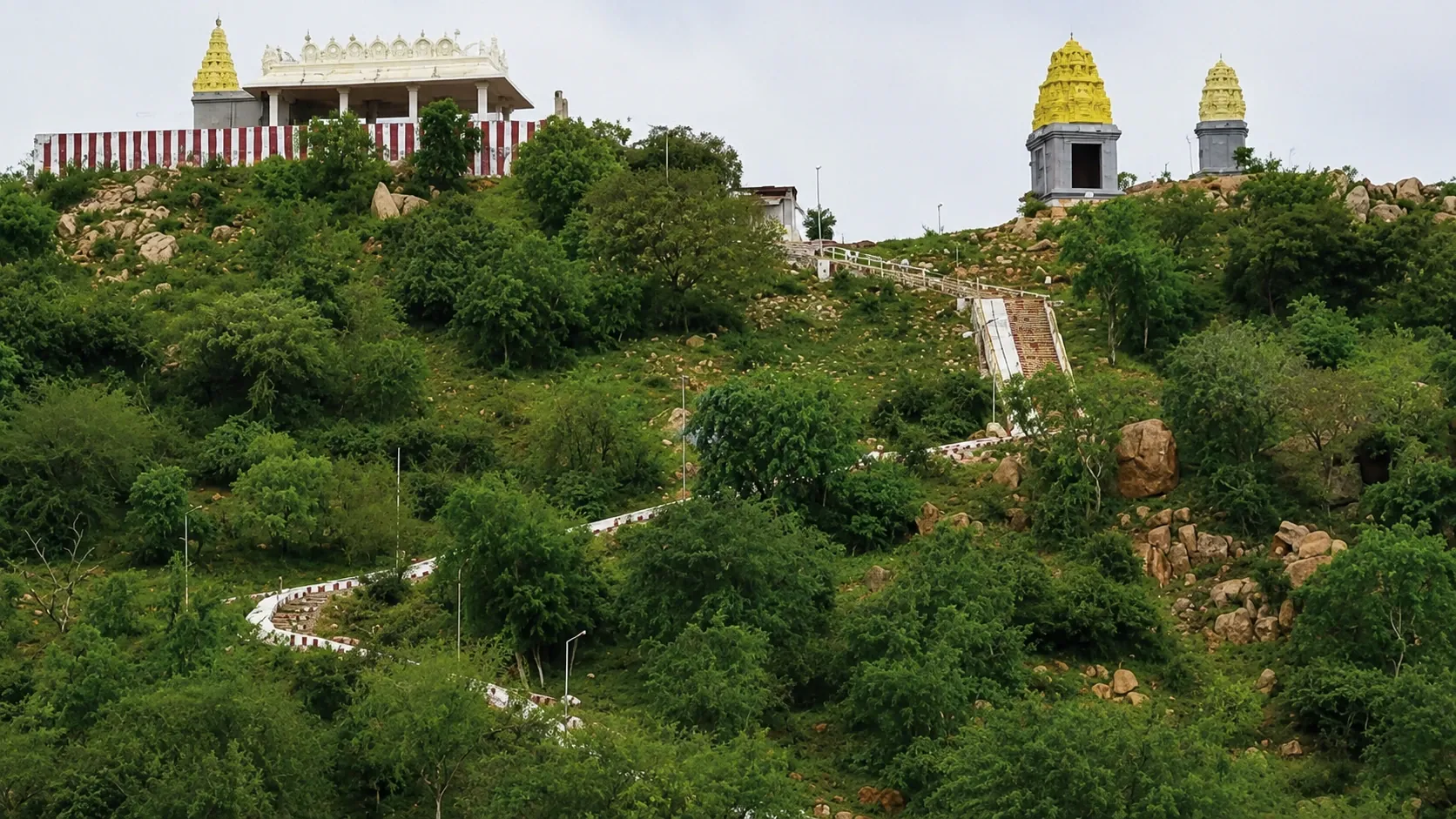
On the sacred slopes of Thiruparankundram, where siddhars once meditated for gnana, a new chapter of learning begins.
There are places in Tamil Nadu that do not merely hold history - they hold intention. Thiruparankundram, one of the six sacred abodes of Lord Murugan, is one such place. And on its northeastern slope rises a hillock known to devotees and siddha tradition as Kakabujandar Malai - named after Siddhar Kakabujandar, revered as one of the eighteen great siddhars of the Tamil tradition.
It is in this very landscape, steeped in centuries of tapas and gnana, that the Sri Murugan Research Centre (SMRC) has now been established on the slopes of this hillock - and for those who know the spiritual weight this land carries, this is no coincidence. It is, as devotees would say, the unfolding of divine will - Muruga Kirupai, the grace of Lord Murugan himself, choosing this ground once again to be a seat of learning.
A Land Consecrated by Siddhas
Long before any modern institution stood here, this hillock was already sacred ground for the pursuit of knowledge in its highest form. Tradition holds that Siddhar Kakabujandar himself dwelt and meditated on this very hill - and it is from his presence that the hillock draws its name.
He was not alone. Across generations, this same soil drew some of the most revered names in the siddha lineage to walk its slopes in search of gnana:
- Machamuni Siddhar (Nondi Siddhar): whose jeeva samadhi rests atop Thiruparankundram hill at the Kasi Viswanathar temple, and who - siddha tradition holds - received esoteric teachings connected to Kakabujandar himself.
- Soottukkole Mayandi Swamigal: who, after years of wandering and after attaining Nirvikalpa Samadhi at the Pothigai Hills, chose to settle permanently at the foothill of this very hillock, dedicating his life to spreading bhakthi among the people of the region.
- Somappa Swamigal: who arrived at this hillock during the construction of the Bala Dhandapani temple at its summit, and remained here in deep tapas for decades.
Generation after generation, siddha after siddha, this hillock kept calling seekers of truth to itself. Why would so many masters of yoga, alchemy, and inner science converge upon one modest hill near Madurai, if not because the land itself carries a vibration uniquely suited to awakening?
Thiruparankundram as Mooladhara - The Root of Inner Ascent
In the subtle geography that devotees and yogic tradition draw across sacred landscapes, Thiruparankundram is regarded by many as embodying the Mooladhara Chakra - the root chakra, the very foundation from which all spiritual energy rises. It is fitting, then, that this should be the first of Murugan's six abodes (Arupadai Veedu) - for the root is always the beginning.
Just as the Mooladhara is the seat from which kundalini shakti begins its ascent toward higher awareness, Thiruparankundram stands as the grounding point, the foundation stone, from which the seeker's journey toward gnana (wisdom) and viveka (discernment) begins.
It is no wonder, in this understanding, that a hillock resting within this very energy field became the chosen ground for siddhas across centuries to pursue the highest knowledge - not worldly information, but gnana: direct, discriminative wisdom. This hillock was never simply a hill. It was a laboratory of the inner sciences, a quiet university of the soul, long before the word "university" existed.
Grace Repeating Itself
When we look at what has grown around this land in modern times - Thiagarajar College of Engineering, Kendriya Vidyalaya, and now the Sri Murugan Research Centre rising on the very slopes of Kakabujandar Malai - it is hard, for those with faith, not to see a thread of continuity here.
The siddhas came to this land to seek knowledge in the deepest, most inward sense. Centuries later, institutions of learning have risen on the same soil, seeking knowledge in the outward, structured sense of modern research and education.
Two different languages - gnana and research, tapas and technology - describing what may be, at its root, the same impulse: the pull of a sacred hill that has always called seekers of truth to itself.
For devotees, the founding of the Sri Murugan Research Centre here is more than an institutional milestone. It is felt as a continuation of Muruga's own grace over this land - the same Lord who chose Thiruparankundram as his first abode among the six, now presiding once more as knowledge takes new form on the same slopes where Kakabujandar, Machamuni, Mayandi Swamigal, and Somappa Swamigal once sat in silence, seeking the light of gnana.
A Living Tradition, Still Unfolding
What makes Kakabujandar Malai remarkable is that its story has never really stopped being written. It began - in devotional memory - with a siddha who is remembered as the very embodiment of knowledge in the siddha lineage. It continued through generations of saints who were drawn, almost magnetically, to walk the same ground in pursuit of the same light. And it continues today, as new seekers - students, researchers, scholars - arrive at the foot of the same hill, to pursue knowledge of their own kind.
Whether one arrives at Kakabujandar Malai as a pilgrim seeking blessings, a student pursuing a degree, or a researcher chasing an idea - the land, in the eyes of the devoted, is quietly doing what it has always done: drawing knowledge-seekers to itself, and offering its ancient grace to whoever comes with sincerity.
Vetrivel Veeravel Muruganukku Arohara.
This piece reflects devotional tradition and local siddha-lineage beliefs associated with Thiruparankundram and Kakabujandar Malai, as passed down among devotees and researchers of the region.
One Life: Live it well
Sukhama Santhoshama Ananthama